A Water Purification System in Tucson can make a major difference when you want cleaner, better-tasting water for your home, business, or well. But not every purification system works the same way. Different technologies target different contaminants, so choosing the right system starts with understanding what each method can and cannot remove.
The five common types of water purification systems are reverse osmosis, activated carbon filtration, ultraviolet (UV) purification, distillation, and ion exchange. In many homes and commercial properties, two or more technologies are combined to create a multi-stage treatment system. The U.S. Environmental Protection Agency (EPA) explains that no single treatment technology removes every contaminant, which is why treatment should be matched to the water-quality problem.
For Tucson homeowners, this is especially important because water treatment needs can vary depending on the property’s water source, plumbing, and desired use.
1. Reverse Osmosis Water Purification Systems
Reverse osmosis, commonly called RO, is one of the most widely used purification technologies for drinking water. A Water Purification System in Tucson using reverse osmosis forces water through a semi-permeable membrane under pressure.
The membrane allows water molecules to pass while rejecting many dissolved substances. According to the EPA, reverse osmosis can reduce a broad range of contaminants, including many dissolved solids, inorganic contaminants, radionuclides, and synthetic organic chemicals.
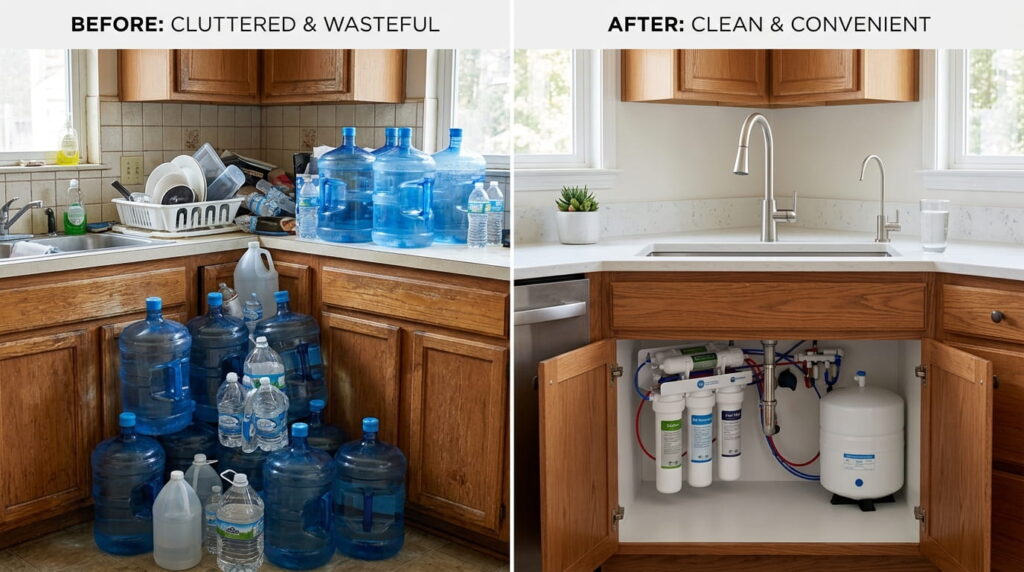
A typical residential RO system may include:
- Sediment pre-filter
- Carbon pre-filter
- Reverse osmosis membrane
- Post-carbon filter
- Storage tank
- Dedicated drinking-water faucet
What can reverse osmosis help reduce?
Depending on the system and certification, RO can reduce substances such as:
- Dissolved salts
- Sodium
- Some metals
- Some nitrates
- Some PFAS
- Certain pesticides
- Certain organic chemicals
EPA notes that point-of-use RO systems can potentially reduce contaminants including lead, VOCs, PFAS, arsenic, bacteria, and viruses, although performance depends on the specific system and its certification.
A Tucson consideration
Reverse osmosis can produce wastewater. The City of Tucson notes that some RO systems can use several gallons of water for each gallon of treated water, although newer efficient systems can reduce this amount.
2. Activated Carbon Filtration Systems
Activated carbon filtration is another popular purification method. It works through adsorption, where certain contaminants attach to the porous surface of the carbon.
The EPA describes granular activated carbon as a highly porous material with a large internal surface area. It can be manufactured from materials including coconut shells, wood, coal, and other carbon-rich sources.
Carbon filtration is particularly useful for improving:
- Taste
- Odor
- Chlorine-related taste
- Some organic chemicals
- Certain disinfection byproducts
The City of Tucson states that activated carbon filters can improve unwanted tastes and odors and may reduce certain organic chemicals, but they do not soften water or disinfect it.
This makes carbon filtration a useful option when the primary concern is the taste or smell of tap water rather than dissolved minerals or hardness.
Is carbon filtration enough by itself?
Not always.
If your water has multiple problems, a carbon filter may need to be combined with other technologies. For example, a household might use sediment filtration followed by carbon filtration and then reverse osmosis for drinking water.
3. Ultraviolet Water Purification Systems
Ultraviolet purification, or UV water treatment, uses ultraviolet light to help control microorganisms in water.
Instead of physically filtering contaminants through a membrane, UV treatment exposes microorganisms to UV energy. This can interfere with their ability to reproduce.
UV treatment is particularly useful for water where microbial contamination is a concern, including certain private well applications.
However, UV does not solve every water-quality problem. It is not designed to remove dissolved minerals, hardness, salts, or many chemical contaminants.
For that reason, UV systems are often paired with filtration.
UV purification for well water
A private well can have different treatment requirements from a municipal water supply. A professional water test can help determine whether UV treatment is appropriate and whether it should be combined with sediment filtration or another technology.
For a Tucson property using well water, the correct treatment system should be based on the actual water analysis rather than simply purchasing a standard UV unit.
4. Water Distillation Systems
Distillation uses heat to purify water.
The process generally involves heating water until it becomes vapor. The vapor is then cooled and condensed back into liquid water. Many contaminants are left behind during this process.
Distillation can reduce various inorganic and organic contaminants and can also control microorganisms. The City of Tucson lists distillation among home-treatment options and notes that it can remove contaminants and kill or remove microorganisms.
However, distillation has limitations.
It can:
- Require significant energy
- Take longer than some filtration methods
- Require regular cleaning
- Produce water without many naturally occurring minerals
- Require proper design where volatile compounds are a concern
For these reasons, distillation may be useful for certain applications but is not automatically the best choice for every Tucson home.
5. Ion Exchange Water Purification Systems
Ion exchange uses specialized resin materials to exchange unwanted ions in water with other ions held by the resin.
This technology is commonly associated with water softeners, which reduce calcium and magnesium responsible for water hardness.
Ion exchange can also be designed for other treatment purposes. EPA identifies cation exchange and anion exchange among established drinking-water treatment technologies.
A water softener can help reduce problems associated with hard water, including:
- Scale buildup
- Mineral deposits
- Soap that does not lather well
- Spots on fixtures
- Reduced efficiency of some appliances
However, a water softener is not the same thing as a complete drinking-water purification system. It primarily addresses hardness rather than every possible contaminant.
Comparison of the Five Water Purification Systems
Choosing the right Water Purification System in Tucson becomes easier when you understand what each technology is designed to accomplish.
| SystemMain PurposeHelps WithMain Limitation | |||
|---|---|---|---|
| Reverse Osmosis | Dissolved-contaminant reduction | Salts, dissolved solids and selected contaminants | Can produce reject water |
| Activated Carbon | Adsorption | Taste, odor and some organic chemicals | Does not soften or disinfect water |
| UV | Microbial control | Certain bacteria, viruses and other microorganisms | Does not remove dissolved minerals |
| Distillation | Separation by boiling/condensation | Many inorganic contaminants and microorganisms | Energy intensive |
| Ion Exchange | Ion removal/exchange | Hardness and selected ions | Not a complete treatment solution |
The EPA’s residential water-treatment guidance emphasizes that technologies differ in what they remove, their limitations, maintenance requirements, and water use.
Which Water Purification System Is Best for a Tucson Home?
There is no single answer.
The best Water Purification System in Tucson depends on your water source and the problem you want to solve.
For example:
| Water ProblemPossible Treatment | |
| Bad taste or odor | Activated carbon |
| Hard water and scale | Ion exchange water softener |
| Dissolved salts/TDS | Reverse osmosis |
| Microbial concerns | UV treatment |
| Multiple contaminants | Combination system |
| Private well concerns | Water testing + customized treatment |
| Drinking-water purification | Point-of-use RO or another appropriate certified system |
A household with hard water may need a softener, while the same home may also install an RO system under the kitchen sink for drinking and cooking.
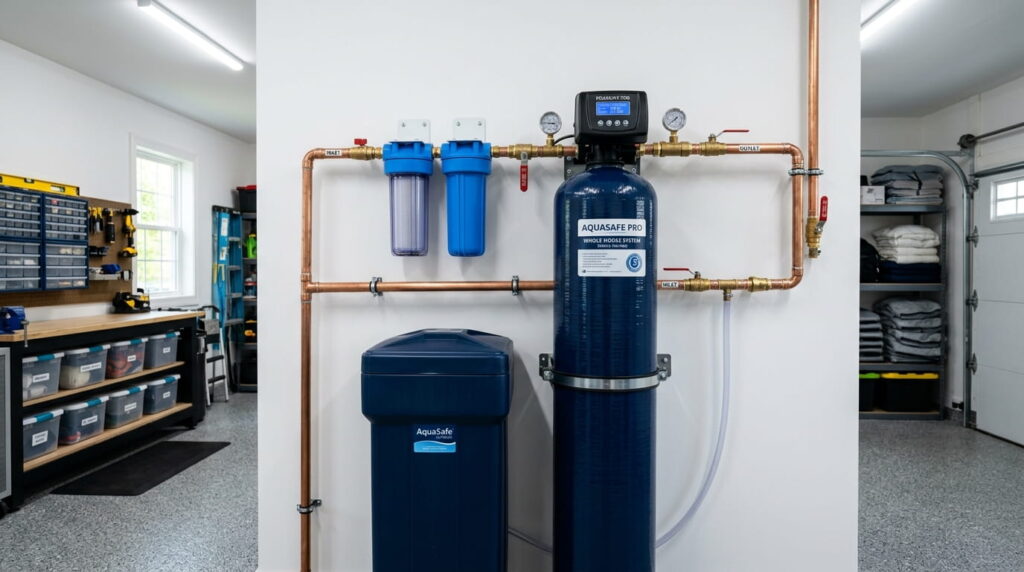
In other situations, a whole-house filtration system may make more sense.
Why Water Testing Should Come First
Before purchasing a purification system, test the water.
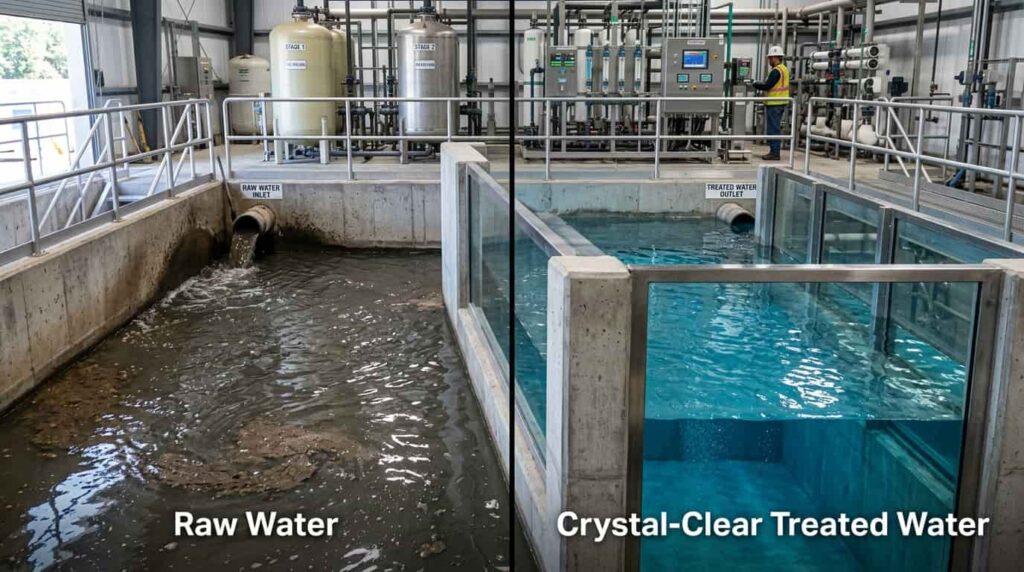
Water can look clear and still contain dissolved substances that are not visible. Likewise, a bad taste does not automatically tell you which contaminant is responsible.
Testing can help determine:
- pH
- Hardness
- Total dissolved solids
- Minerals
- Metals
- Microbial concerns
- Specific contaminants relevant to the water source
This is particularly important for private wells because the treatment needs depend heavily on the individual well.
The City of Tucson also provides water-quality information for its municipal supply, while individual properties can have different treatment requirements based on their plumbing, source, and desired water use.
Whole-House vs. Point-of-Use Purification
Another important decision is where the treatment should occur.
Whole-House Treatment
A whole-house system treats water before it reaches multiple fixtures.
It can be useful when you want to address a water-quality issue throughout the property, such as hardness, sediment, or certain other contaminants.
Point-of-Use Treatment
Point-of-use systems treat water at a specific fixture.
A common example is an RO system installed beneath a kitchen sink for drinking and cooking water. EPA describes point-of-use RO systems as systems connected to a single fixture, although they can also be used in commercial settings.
The right choice depends on whether your concern affects the entire property or only the water you consume.
Real-World Water Treatment Statistics and Facts
Understanding a few real-world figures can help homeowners make better decisions.
| FactWhat It Means | |
| EPA recognizes multiple drinking-water treatment technologies | Different contaminants require different treatment approaches |
| Some residential RO systems can produce multiple gallons of reject water per gallon treated | Efficiency matters when choosing an RO system |
| Tucson monitors water-quality parameters including hardness and total dissolved solids | Local water characteristics should be considered |
| Activated carbon does not soften or disinfect water | Carbon should not be selected as a universal treatment |
| EPA recommends considering certified performance claims | Look for systems tested for the contaminants you want to reduce |
The City of Tucson specifically warns that some RO systems can generate significant wastewater, while EPA’s WaterSense program has established efficiency criteria for qualifying point-of-use RO systems.
How Desert Water Services Can Help
If you are unsure which treatment technology your property needs, Desert Water Services can help you evaluate your water-treatment options in Tucson, AZ.
Desert Water Services, LLC
Desert Water Services, LLC Web Address: 9707 E Sabino Estates Dr, Tucson, AZ 85749 Phone: +15203278426
A good treatment plan should start with the water problem, not the equipment.
For a residential property, the solution could involve a water softener, whole-house filtration, reverse osmosis, UV purification, or a combination of technologies.
For commercial properties, treatment requirements may be different because water volume, equipment requirements, and operating conditions can vary.
Private well owners may also require specialized treatment based on well-water testing.
Final Thoughts on Water Purification Systems
The five major water purification approaches discussed here are reverse osmosis, activated carbon filtration, ultraviolet purification, distillation, and ion exchange.
Each system has a specific purpose. RO is useful for reducing many dissolved contaminants, carbon can improve taste and odor, UV targets microorganisms, distillation uses evaporation and condensation, and ion exchange can address hardness and selected dissolved ions.
The best Water Purification System in Tucson is therefore not necessarily the most expensive or most advanced system. It is the system that matches your water quality, property, budget, and treatment goals.
If you are dealing with hard water, unusual taste or odor, well-water concerns, sediment, or other water-quality problems, start with testing and then select treatment based on the results.
Frequently Asked Questions
1. What is the best Water Purification System in Tucson?
The best system depends on the contaminants and your treatment goals. Reverse osmosis, carbon filtration, UV, distillation, and ion exchange each address different water-quality concerns.
2. What are the five types of water purification systems?
The five commonly used types are reverse osmosis, activated carbon filtration, ultraviolet purification, distillation, and ion exchange. Many treatment systems combine two or more technologies.
3. Is reverse osmosis good for Tucson drinking water?
Reverse osmosis can be an effective option for drinking water when the system is properly selected and maintained. EPA notes that RO can reduce many dissolved contaminants, although performance varies by system and contaminant.
4. Does a carbon filter remove hard water?
No. Activated carbon can improve taste and odor and reduce certain organic contaminants, but the City of Tucson states that carbon filtration does not soften water.
5. Is UV purification good for well water in Tucson?
UV can be useful when microbial control is needed, but it does not remove hardness, salts, or most dissolved chemicals. Well water should be tested before choosing a treatment system.
6. Does reverse osmosis waste water?
Yes. RO produces a treated-water stream and a reject-water stream. The amount of water used varies by system. The City of Tucson notes that some systems can use several gallons of water to produce one gallon of treated water.
7. What water purification system removes the most contaminants?
No single system removes every contaminant. RO can address a broad range of dissolved contaminants, while carbon, UV, ion exchange, and other technologies target different problems. EPA recommends matching treatment technology to the contaminants of concern.
8. Do Tucson homes need a whole-house water purification system?
Not necessarily. If your concern is limited to drinking and cooking water, a point-of-use system may be sufficient. If the problem affects the entire home, whole-house treatment may be more appropriate.
9. How often should water purification filters be replaced?
Replacement schedules depend on the technology, water quality, system capacity, and manufacturer’s instructions. Following the manufacturer’s maintenance schedule is important for maintaining treatment performance.
10. Where can I get a Water Purification System in Tucson?
Homeowners, well owners, and businesses can contact Desert Water Services in Tucson, AZ to discuss water treatment options. A professional evaluation can help determine whether filtration, reverse osmosis, water softening, UV treatment, or a combination system is appropriate.