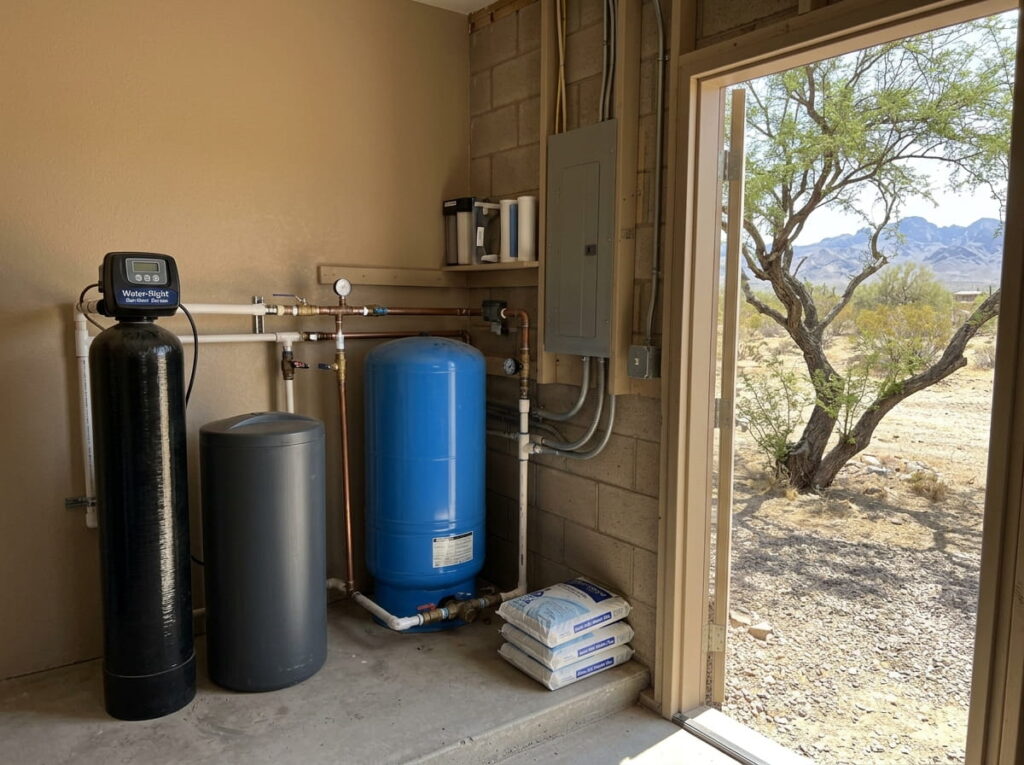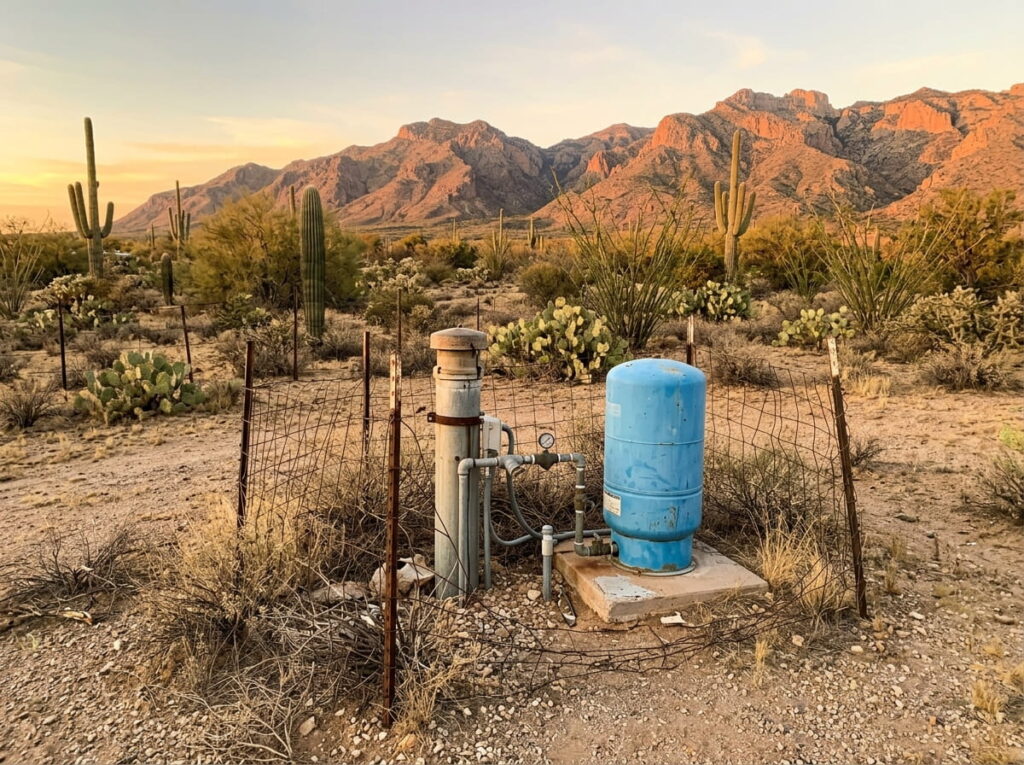
Well water treatment Tucson specialists start every job with one number that many well owners have never measured: the flow rate. Your well flow rate decides which treatment system in Tucson will work at your property and which one will choke, foul, or fail early. Measure the well flow rate first, and the treatment system choice in Tucson gets much easier. This how to guide shows you how to measure well flow rate at home, what the numbers mean, and why a treatment system in Tucson needs that figure before anyone orders equipment.
Quick answer: Fill a 5 gallon bucket from the spigot closest to your pressure tank and time it. Divide 5 by the seconds, then multiply by 60 to get gallons per minute (GPM). Repeat the test while the pump runs. Compare your result with the backwash and service flow ratings of the treatment system you plan to buy. If the well flow rate falls short, the treatment system in Tucson cannot clean its own media properly.
Why Flow Rate Matters for Well Water Treatment
Most well treatment equipment, including softeners, iron filters, and combination units, cleans itself through a backwash. During backwash, water flows upward through the tank to lift and rinse the media. Each tank size needs a minimum flow to do that job. Your well flow rate must meet that minimum, or the treatment system in Tucson leaves dirt, iron, and bacteria inside the media bed.
Well flow rate also affects how a treatment system in Tucson handles daily use. A treatment system has a service flow rating, which tells you how many gallons per minute it can treat while still doing its job. If your household demand at peak times beats that rating, untreated water slips through.
In short, the well flow rate sets the upper limit for any treatment system in Tucson that you connect to your well. No setting or upgrade can push more water through the treatment system than the well flow rate allows.
Well Yield vs Pump Rate: Know the Difference
People often mix up two different numbers.
- Well yield means how fast the aquifer refills the well. The driller usually measures it when the well goes in.
- Pump rate means how fast your pump pushes water out of the well into the pressure tank and house.
Your usable flow equals the lower of the two. A strong pump in a low yield well can pull the water level down until the pump runs dry. A weak pump in a strong well limits you even though the aquifer could give more. Either way, the treatment system in Tucson only sees the well flow rate that reaches it. When we size a treatment system in Tucson, we check both the well yield and the flow rate at the tap.
The Arizona Department of Water Resources keeps records for registered wells, and many records include the driller’s log with the yield measured at drilling. That number gives you a starting point, but yields can change over the years, so a current test always wins.
Method 1: The Bucket Test
This test takes about ten minutes and tells you the delivered flow at your tap.
You need: a 5 gallon bucket, a stopwatch or phone timer, and a helper if possible.
- Pick the outdoor spigot closest to the pressure tank, before any filter or treatment equipment.
- Turn off every other faucet, appliance, and irrigation line in the house.
- Open the spigot fully and let it run until the pump turns on.
- Place the bucket under the flow and start the timer.
- Stop the timer when the bucket reaches the 5 gallon line.
- Do the math: 5 divided by seconds, then multiplied by 60.
Example: If the bucket fills in 40 seconds, the flow equals 5 ÷ 40 × 60, or 7.5 GPM.
Run the test three times and use the average, since one reading can mislead you when you size a treatment system for a Tucson well. Write down the date and time. Your well flow rate may read lower in late spring, when Tucson heat drives water use up and many wells see their water level drop.
Method 2: The Pressure Tank Drawdown Test
The bucket test measures flow at the spigot. The drawdown test estimates how fast your pump refills the tank, which adds a second check on the well flow rate before any treatment system goes in at your Tucson property.
- Open a faucet and let water run until the pump turns on.
- Shut the faucet and note the time it takes for the pump to shut off.
- Open the faucet again into a bucket and collect every drop until the pump turns back on. This volume equals your tank’s drawdown.
- Divide the drawdown gallons by the pump’s run time in minutes.
Example: A drawdown of 10 gallons and a pump run of 1.5 minutes points to about 6.7 GPM.
This test helps reveal a weak pump, a waterlogged tank, or a pressure switch problem. All three lower the well flow rate that a treatment system in Tucson actually receives.
Method 3: A Professional Flow and Yield Test
A professional test runs the well for an extended period while measuring flow and pressure. It shows whether the well can hold its flow under a sustained draw, such as a long backwash cycle on a hot afternoon. For new construction, rural properties, and shared wells, a professional test protects you from buying a treatment system that your well cannot support. In Tucson, we recommend this test whenever the well flow rate looks borderline.
What Your Results Mean
| Your Flow Result | What It Usually Means | Next Step |
|---|---|---|
| Strong and steady across tests | The well and pump can likely support standard treatment equipment | Match the system’s backwash spec to your number |
| Starts strong, then drops | Low yield or falling water level | Ask for a professional yield test before buying |
| Low on every test | Small pump, clogged lines, or a low yield well | Check the pump and plumbing, then size equipment for low flow |
| Pump cycles on and off fast | Waterlogged tank or a pressure switch problem | Service the tank before adding treatment |
Every manufacturer prints a backwash flow requirement for each tank size. Compare that printed number with your well flow rate before you buy any treatment system in Tucson. A treatment system in Tucson that needs more flow than your well can give will never clean itself fully.
How Tucson Conditions Affect Well Flow Rate and Treatment System Choice
Tucson weather puts unusual stress on private wells. Long dry stretches and triple digit summers push household water use up, often at the same time that groundwater levels sit at their lowest. Monsoon storms can bring power outages and surges that interrupt pumps and control valves. All of that shapes how a treatment system in Tucson performs on a well.
Three local habits help:
- Test twice a year. Measure your well flow rate once in winter and once in late spring. The difference between the two readings tells you how much margin you have.
- Watch for sand and sediment. Some wells push fine sediment, especially when the water level drops. Sediment wears valves and fouls media, so a prefilter may need to sit in front of the treatment system.
- Schedule regenerations at night. A treatment system in Tucson that backwashes at 2 a.m. competes with nothing else for water. Daytime backwashes fight irrigation, laundry, and showers for the same well flow rate.
These steps cost little, and they protect the equipment you buy. Pair them with a solid flow test and a lab analysis, and your well flow rate and treatment system choice in Tucson will line up from the first day.
Common Mistakes When Sizing a Treatment System
- Buying by house size alone. Square footage tells you nothing about your well.
- Testing after the pressure tank only. Measure before any filter so old equipment does not skew the number.
- Ignoring summer conditions. Test during your heaviest use season when you can.
- Skipping the water test. Flow tells you how much water you have. A lab test tells you what is in it. A treatment system in Tucson needs both numbers.
- Choosing the biggest tank. Bigger tanks need more backwash flow. An oversized system on a modest well flow rate can perform worse than a right sized one.
Test the Water, Not Just the Flow
The EPA reminds private well owners that they carry responsibility for their own water quality. Its private well guidance recommends regular testing for bacteria and other contaminants. In southern Arizona, a full analysis often looks at hardness, iron, manganese, pH, and bacteria. Those results, paired with your well flow rate, tell us exactly which treatment system fits your Tucson property.
How We Match Equipment to Your Well
Desert Water Services has treated well water across southern Arizona since 1998, and every treatment system we install in Tucson starts with a well flow rate check. For unchlorinated well water, we often recommend the Sanitizer Plus series, a Water Right system with patented self-chlorinating technology that cleans its own media. It helps soften water, remove iron and manganese, and raise low pH, all in one unit. Like any backwashing system, it needs the right flow, so we confirm your numbers before installation.
Curious how that system holds up over time? Read our look at Sanitizer Plus long term performance and what five years of ownership looks like in Tucson. To explore all options, visit our well water treatment system page.
Book a Professional Flow Test: Call (520) 327-8426 or schedule a free consultation. We will measure your well flow rate, test your water, and size a treatment system that fits your Tucson well.
Frequently Asked Questions
1. What is a good well flow rate for a treatment system in Tucson?
There is no single well flow rate that fits every treatment system in Tucson. The right well flow rate depends on the backwash requirement of the treatment system you choose and your household’s peak demand. Compare your measured GPM with the manufacturer’s printed spec.
2. How do I measure my well flow rate at home?
Time how long a 5 gallon bucket takes to fill at the spigot nearest your pressure tank. This simple well flow rate test works on any Tucson property before a treatment system goes in. Divide 5 by the seconds and multiply by 60 to get gallons per minute.
3. What happens if my well flow rate is too low for my treatment system?
The treatment system cannot backwash properly, a common problem on low flow rate wells around Tucson. Iron, sediment, and bacteria stay trapped in the media, performance drops, and the media may foul early.
4. Is well yield the same as flow rate?
No. Well yield measures how fast the aquifer refills the well. Flow rate at the tap reflects both the yield and your pump. Your usable flow equals the lower of the two.
5. Where can I find my well’s original yield in Arizona?
The Arizona Department of Water Resources keeps records for registered wells, and many include the driller’s log with the yield measured at drilling.
6. Does well flow rate change during the year in Tucson?
It can. Heavy summer use and dropping water levels can lower your flow rate. Testing during your busiest season gives the most useful number for sizing a treatment system in Tucson.
7. Should I test flow before or after my pressure tank?
Test at a spigot near the pressure tank and before any filters or treatment equipment, so an existing treatment system does not lower your well flow rate reading in Tucson.
8. Can a bigger treatment system fix a low flow problem?
No. A bigger treatment system usually needs more backwash flow, which makes a low well flow rate problem in Tucson worse. Right sized equipment works better on a modest well.
9. What water tests should a Tucson well owner run?
The EPA recommends regular testing for bacteria and other contaminants. A full analysis for southern Arizona wells often adds hardness, iron, manganese, and pH.
10. Who offers professional well flow rate testing in Tucson?
Desert Water Services measures well flow rate, tests well water, and installs treatment systems across Tucson and nearby rural areas. Call (520) 327-8426 to book a test.