Shopping for a softener gets confusing fast. Every brand claims to be the best, and the specs don’t always make sense at first glance. If you’re searching for the best water softener 2500 sq ft Tucson homes can rely on, the first thing to know is that square footage alone won’t tell you the right size. It’s a helpful starting point, but the real answer depends on your water hardness, how many people live with you, and how much water flows through your pipes at once.
Let’s walk through how to choose the right system for a home this size.
Why Square Footage Is Only a Starting Point
A 2,500 square foot home usually has three or four bedrooms and two to three bathrooms. That gives a rough picture of water use. But two homes the same size can use very different amounts of water. A couple working from home and a family of five with teenagers won’t regenerate a softener at the same pace.
So when people ask about the best water softener for a 2,500 sq ft Tucson home, the honest answer is that the best one is the one sized to your household and your water.
The Three Numbers That Matter
1. Your Water Hardness
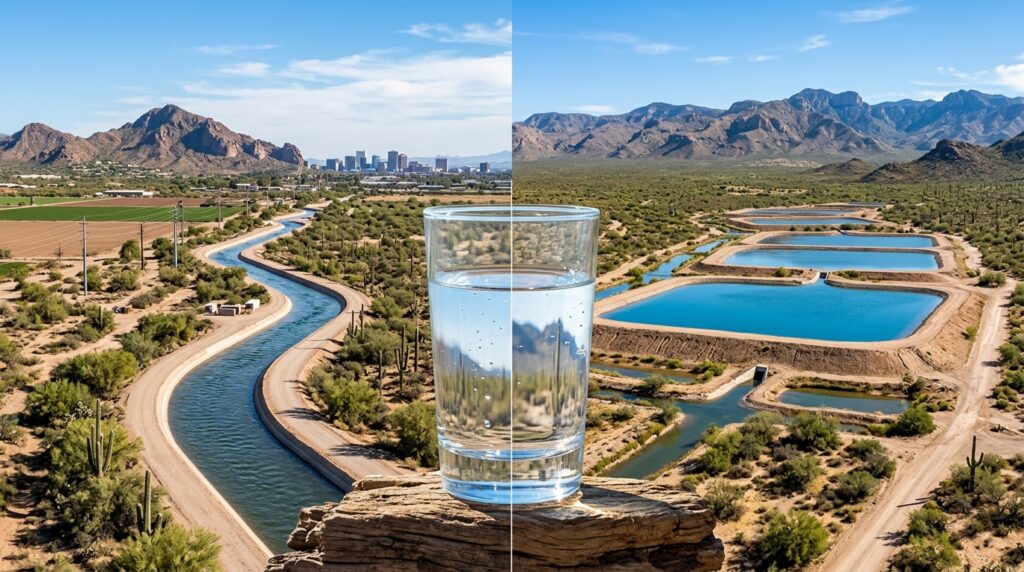
Hardness is measured in grains per gallon. Tucson’s water is hard, and it varies by neighborhood because different areas get different blends of recharged Colorado River water and native groundwater. Don’t rely on a citywide average. Test your own tap.
2. How Many People Live in the Home
Softener sizing commonly uses an estimate of about 75 gallons of water per person per day. Your actual use may be higher or lower, but it’s a useful benchmark.
3. Your Peak Flow Rate
Flow rate is how many gallons per minute your home uses when several fixtures run at once. A home with two and a half bathrooms might run two showers, the dishwasher, and the washing machine at the same time. If the softener can’t handle that flow, you’ll notice a pressure drop.
A Simple Sizing Example
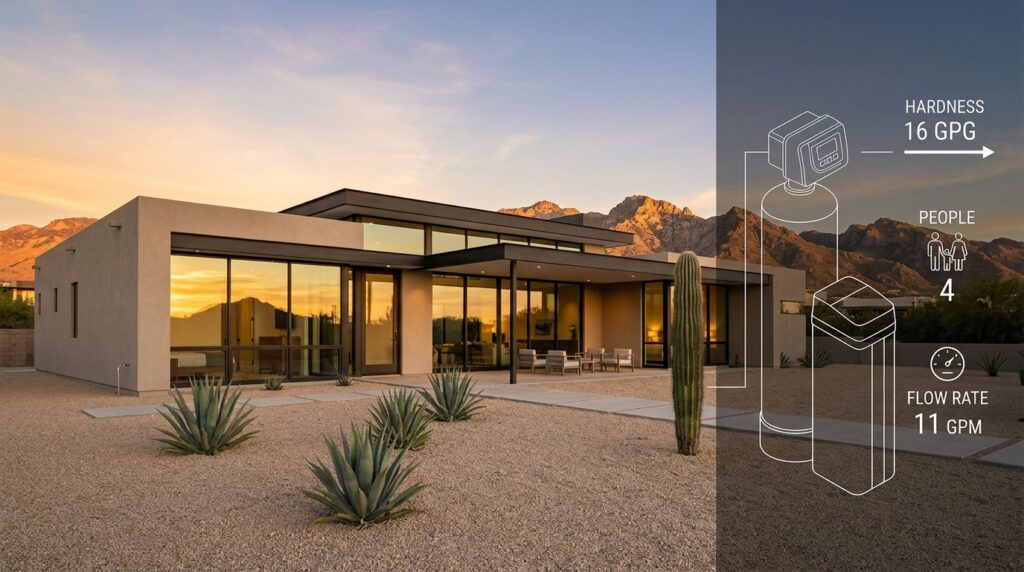
Let’s say a family of four lives in a 2,500 square foot Tucson home, and their water tests at 12 grains per gallon.
4 people × 75 gallons = 300 gallons per day
300 gallons × 12 grains = 3,600 grains removed per day
3,600 × 7 days = 25,200 grains per week
A softener sized so it regenerates about once a week or so, while running at an efficient salt setting, would suit this family. Softeners rarely deliver their full advertised grain capacity at efficient salt settings, which is why installers usually choose a unit with a higher rated capacity than the weekly number. Many homes of this size end up with a system somewhere around the 32,000 to 48,000 grain range, but your water test and household size decide the final number.
Salt Based vs. Salt Free
This choice matters in Tucson.
Salt based softeners use ion exchange to physically remove calcium and magnesium. This is true water softening.
Salt free conditioners change how minerals behave so they’re less likely to form scale, but they don’t remove hardness. You may still see spots and film.
For a Tucson home with hard water, a salt based system is the standard choice when your goal is soft water. If you want to reduce sodium, potassium chloride can be used in place of sodium chloride in many systems.
Features Worth Paying For
Metered, On Demand Regeneration
Older systems regenerate on a timer whether you need it or not. Metered valves track actual water use and regenerate only when needed. That saves salt and water.
The Right Valve Size
For a 2,500 square foot home with multiple bathrooms, valve size matters for flow. A properly sized valve helps prevent pressure loss when several fixtures run together. Your installer should size the valve to your plumbing and peak demand.
Chlorine Protection
Tucson city water is disinfected with chlorine, which slowly breaks down softener resin. Systems with a carbon stage ahead of the resin help protect it and also improve the taste and smell of water throughout the home.
Certification
Look for systems certified to NSF/ANSI standards. Standard 44 covers softener performance, and Standard 42 covers aesthetic effects like chlorine reduction.
Warranty
A strong warranty on the valve, tank, and resin protects your investment. Read the terms carefully.
A System Worth Considering
The Reionator Pro Series from WaterTech is one option many Tucson homeowners look at for homes this size. It uses a multi media bed to soften water and reduce chlorine in one tank, a metered Triton control valve, and AquaHelix distribution plates designed for efficiency. It’s certified to NSF Standards 42 and 44 and is sold and installed through authorized dealers. As with any softener, it should be sized to your water test and household.
Don’t Forget Installation
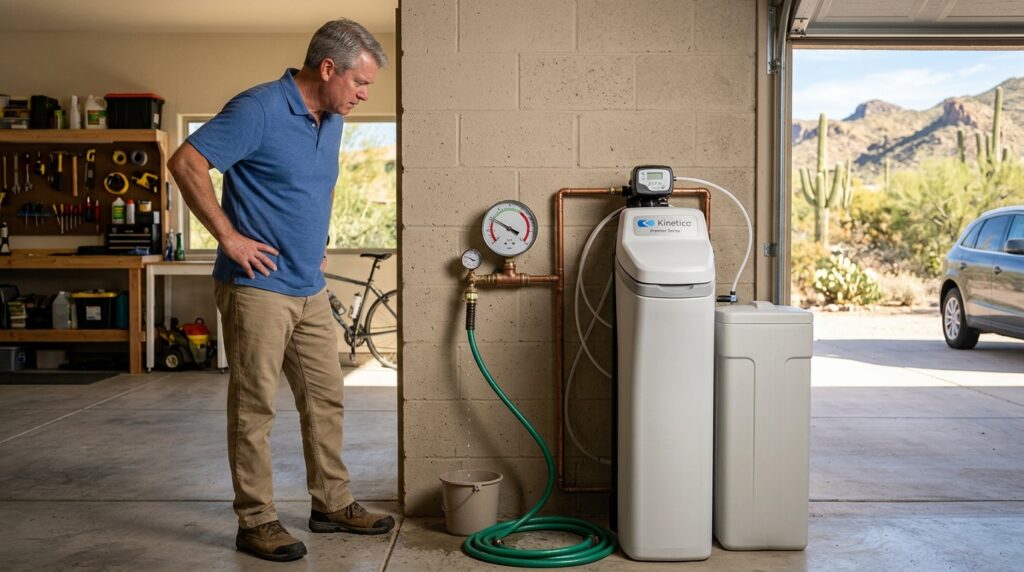
Even the best water softener for a 2,500 sq ft Tucson home won’t perform well if it’s installed poorly. Many Tucson homes have a pre plumbed softener loop in the garage, which makes water softener installation in Tucson easier. If yours doesn’t, the installer will need to connect to the main line.
Other installation details include a nearby drain for regeneration water, an electrical outlet, a bypass valve for service, and enough space for the brine tank. Professional installation also helps protect your warranty.
Mistakes to Avoid
Buying based only on square footage. Choosing the biggest system possible, which can regenerate too rarely and let resin sit. Choosing a unit that’s too small, which regenerates constantly and wastes salt. Skipping the water test. Ignoring flow rate in a home with multiple bathrooms.
Want the right size the first time? Get Sizing Recommendation and let a local specialist test your water and match a system to your home.
Frequently Asked Questions
1. What size water softener do I need for a 2,500 sq ft home?
It depends on hardness, household size, and peak flow. Many homes this size fall around 32,000 to 48,000 grains, but a water test and household count decide the right size.
2. Does square footage determine softener size?
Not directly. Square footage hints at the number of bathrooms and occupants, but sizing is based on hardness, daily water use, and flow rate.
3. How do I calculate softener capacity?
Multiply the number of people by about 75 gallons per day, then by your hardness in grains per gallon. Multiply by seven to estimate weekly grains removed.
4. What is the best type of softener for Tucson?
A salt based ion exchange softener is the standard choice because it actually removes hardness minerals. Salt free conditioners don’t remove hardness.
5. Is a metered softener better than a timer softener?
Yes, for most homes. Metered systems regenerate based on actual water use, which saves salt and water compared to fixed timer schedules.
6. What happens if my softener is too small?
It regenerates too often, uses more salt and water, and may let hard water through during high use periods.
7. What happens if my softener is too big?
An oversized unit may regenerate too rarely, costs more upfront, and may not perform as efficiently as a properly sized system.
8. Do Tucson homes have softener loops?
Many do, especially newer homes. A loop is a pre plumbed connection in the garage that makes installation simpler.
9. Does chlorine damage softener resin?
Yes, over time. A carbon stage ahead of the resin reduces chlorine and helps the resin last longer.
10. How long does water softener installation take?
A standard installation with an existing loop often takes a few hours. Homes without a loop may take longer.