Every year your water utility mails out a document full of acronyms, decimal points, and units most people have never seen outside a chemistry class. Most homeowners glance at it, notice nothing is flagged in red, and toss it in the recycling.
That is a missed opportunity. The report tells you a lot about what is coming out of your tap, and once you know how to read it, you can spot the difference between a number that is legally fine and a number that explains why your dishes have spots and your water heater died at year seven.
Desert Water Services, LLC works with these reports constantly. Here is how to read yours.
What the Report Is and What It Is Not
The document is officially called a Consumer Confidence Report, and federal law requires community water systems to publish one annually. It summarizes testing performed on the distribution system during the previous calendar year.
Two limitations matter enormously.
First, the report describes water at the treatment plant and in the mains. It does not describe water at your kitchen faucet. Anything that happens in the pipes between the street and your sink, including lead from older solder, copper from corroding lines, or sediment from a disturbed main, will not appear in it.
Second, the report averages results across an entire service area and an entire year. Your neighborhood might sit at the high end of a range while the reported average looks reassuring. This gap is the reason certified water quality testing in Tucson at your own tap remains the only way to know what you are actually drinking.
If you are on a private well, no report exists at all. Well owners are responsible for their own testing, and nobody sends a reminder.
The Table Structure
Almost every report uses the same layout. Once you understand the columns, the rest is straightforward.
Contaminant names the substance tested.
MCL stands for Maximum Contaminant Level, the legal ceiling.
MCLG stands for Maximum Contaminant Level Goal, the level at which no known health effect occurs. This is a health target, not a legal requirement, and it is frequently set at zero for substances with no safe threshold.
Level Detected shows what testing actually found, often as an average alongside a range.
Units are usually ppm, meaning parts per million, or ppb, meaning parts per billion. One ppm equals 1,000 ppb.
Violation answers whether the system exceeded the legal limit.
Likely Source attributes the substance to erosion of natural deposits, runoff, treatment byproducts, or infrastructure.
The trap is treating the Violation column as the only thing that matters. A result can sit just under the MCL, show no violation, and still be worth addressing in your home.
The Numbers Tucson Homeowners Should Look At
Hardness. Often listed as calcium carbonate in ppm or grains per gallon, and sometimes buried in a secondary table because it is unregulated. Divide ppm by 17.1 to get grains per gallon. Anything above 7 grains is hard, and above 10 is very hard. Much of the Tucson area sits in that upper range. Hardness explains scale, spotting, soap scum, dry skin, and shortened appliance life.
Total Dissolved Solids. The combined weight of everything dissolved in the water. The secondary standard is 500 ppm. Higher readings correlate with a mineral or salty taste, and they drive most complaints about how tap water tastes.
Arsenic. Naturally present in southern Arizona geology. The MCL is 10 ppb while the MCLG is zero, which tells you the legal limit reflects treatment feasibility rather than an absence of risk. Any detectable arsenic is worth discussing.
Nitrate. The MCL is 10 ppm. It matters most for infants and pregnant women. Agricultural areas outside the city core see higher readings, and private wells near farmland deserve annual attention.
Chromium. Both total chromium and the hexavalent form appear in some Arizona reports. Hexavalent chromium is not separately regulated federally, so it may be listed for information only.
Disinfection byproducts. Look for TTHM and HAA5. These form when chlorine reacts with organic matter. Levels rise in summer and at the far ends of the distribution system, so your address matters.
Chlorine or chloramine residual. This is intentional and protects the water on its way to you. It also affects taste and odor and is easily removed with carbon filtration at home.
pH. Usually reported in a secondary table. Tucson water tends toward the alkaline side. pH influences how minerals behave and how effectively treatment systems operate.
Reading the Ranges, Not Just the Averages
When a report shows an average of 4 ppb with a range of 1 to 9 ppb, that spread is the real story. The average is a statistic. The range tells you what came out of somebody’s tap on a given day.
Seasonal patterns are common. Disinfection byproducts climb in warm months. Sediment spikes after main breaks or heavy monsoon runoff. Wells shift with the aquifer level.
This is another reason professionals rely on certified water quality testing in Tucson rather than published averages. A sample from your own home on a specific date answers a question the annual report structurally cannot.
What the Report Leaves Out Entirely
Lead and copper are handled under a separate rule with a different structure. Instead of an MCL, they use an action level based on the ninetieth percentile of samples from a selected group of higher risk homes. If your specific house has old solder or brass fixtures, that citywide number says nothing about you. Only a tap sample does.
PFAS compounds appear in some reports and not others depending on the testing cycle and current regulatory status. Absence from the report does not confirm absence from the water.
Bacteria results are typically summarized rather than itemized. Well owners need their own coliform testing at least annually.
Anything that happens after the meter is entirely outside the report’s scope. Your service line, your interior plumbing, your water heater, and your softener all influence what you drink.
Turning the Report Into a Decision
Once you have read yours, the useful next step is comparing it against what you actually experience.
Persistent scale on fixtures and glassware points to hardness that needs a softener regardless of what the report says about safety. A chlorine taste points to carbon filtration. Elevated TDS with a mineral taste points to reverse osmosis at the drinking tap. Any arsenic or nitrate detection points to a treatment method specifically validated for that contaminant, since standard carbon filters do not touch either one.
The report gets you oriented. Confirming your own numbers is where certified water quality testing in Tucson earns its place, because it measures your tap rather than the neighborhood average.
Desert Water Services, LLC uses both together. The report frames the regional picture, and a home sample defines your actual starting point before any equipment is recommended.
Frequently Asked Questions
Where do I find my Tucson water quality report?
Utilities publish it on their websites and mail or link to it annually, usually in spring or early summer. Searching your provider’s name along with Consumer Confidence Report will locate it.
Does no violation mean my water is fine?
It means the system met legal requirements. Legal limits are set by weighing health data against treatment cost and feasibility, and unregulated substances like hardness never appear as violations at all.
Why does my water taste different from my neighbor’s?
Distribution position, plumbing age and material, water heater condition, and how long water sits in your lines all change taste. Two homes on the same street can differ noticeably.
How often should I test my own water?
Private wells should be tested annually for bacteria, nitrates, and the local minerals of concern, and after any change in taste, color, or odor. City connections benefit from certified water quality testing in Tucson when buying a home, after plumbing work, or when symptoms appear.
Can I trust a home test kit?
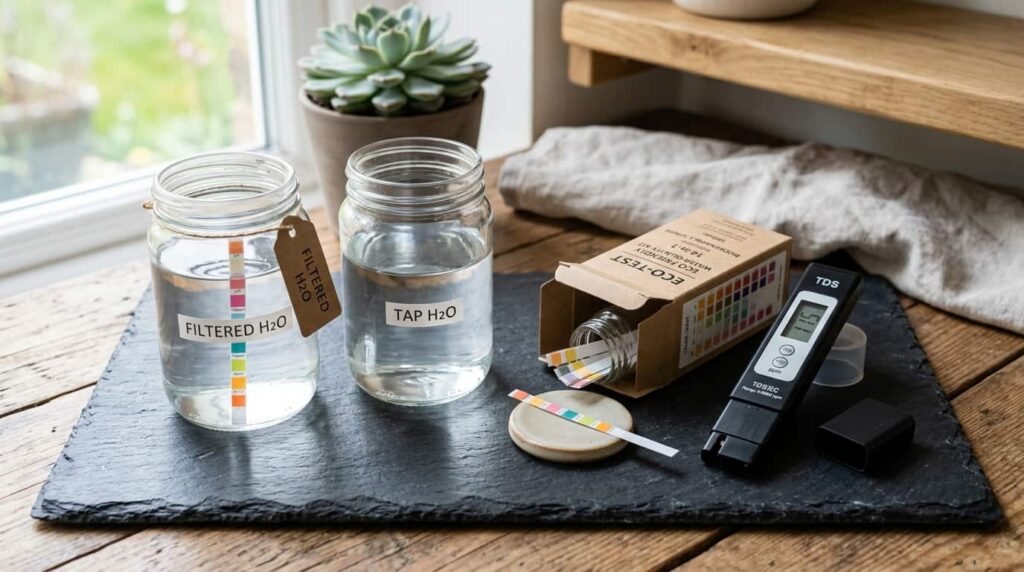
Strips give a rough sense of hardness, chlorine, and pH. They are not reliable for arsenic, lead, nitrates, or bacteria, and they are not accepted for real estate or lending purposes.
What should a professional test cover?
At minimum hardness, pH, total dissolved solids, iron, manganese, arsenic, nitrates, chlorine, and coliform bacteria. Well properties should add hydrogen sulfide and any contaminant known in the local aquifer.