Reverse osmosis Tucson homeowners choose often starts with one big question: should you treat one tap or the whole house? The under-sink vs whole-house RO choice affects your budget, your water bill, and the space in your garage. It also changes how much maintenance you take on each year. Both systems use the same basic idea, a fine membrane that removes salts and dissolved minerals. However, they work at very different scales. In this guide, Desert Water Services LLC compares under-sink vs whole-house RO in plain terms. You will see the real pros and cons of each setup for hard desert water. You will also learn which option makes sense for most local homes, and when the bigger system earns its place.
How Reverse Osmosis Works in Tucson Homes
Reverse osmosis pushes water through a semi-permeable membrane. Water molecules pass through, while most salts and minerals stay behind and flow to the drain. Tucson Water notes that RO purifies water and removes salts, and that it can improve color, taste, and softness. That matters here, because Tucson pulls from a blend of CAP river water and local groundwater. Both sources carry calcium, magnesium, and other dissolved solids. The city also warns that chlorine can harm some RO membranes. For that reason, most systems use a carbon pre-filter to protect the membrane. So every reverse osmosis Tucson setup needs the right pre-filters for local water. That rule applies in both sides of the under-sink vs whole-house RO debate. The membrane is the heart of the system, and pre-filters keep it healthy.
What an Under-Sink RO System Does
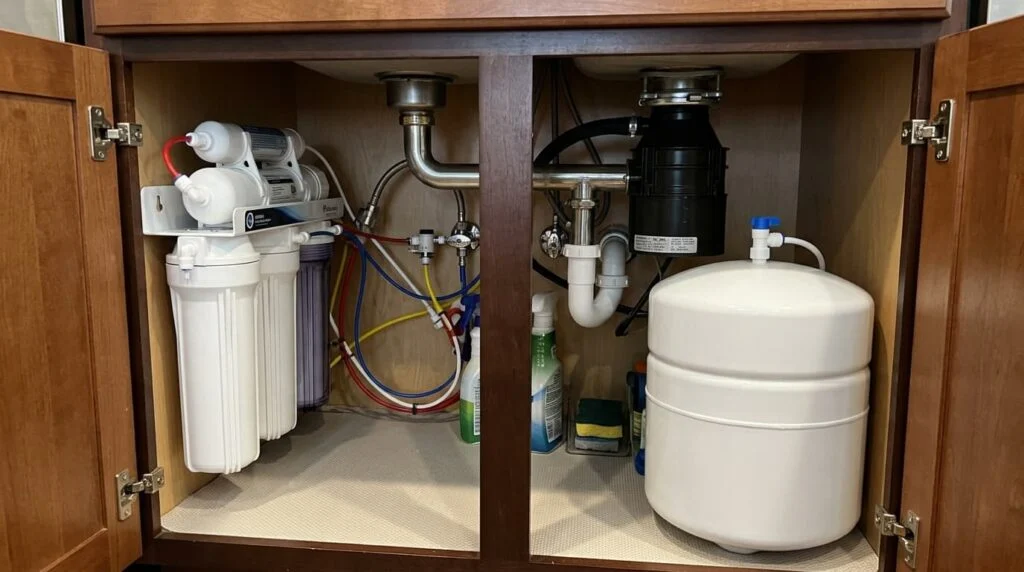
An under-sink RO system treats water at one point of use, usually the kitchen sink. It sits in the cabinet and feeds a small dedicated faucet. Most units include a sediment filter, a carbon filter, the RO membrane, and a final polishing filter. Many also feed the fridge water line and ice maker. Because it only treats drinking and cooking water, it uses less space and produces less waste. That makes it the most common choice for reverse osmosis Tucson families install. You get clean, crisp water for coffee, baby bottles, pets, and soups. Meanwhile, the rest of your home keeps using regular city water for showers and laundry. In the under-sink vs whole-house RO comparison, this setup wins on cost, simple care, and water use for most households.
Under-Sink RO Pros and Cons
| Pros | Cons |
|---|---|
| Lower upfront cost | Treats only one or two taps |
| Fits inside a standard sink cabinet | Uses some cabinet space |
| Easy filter changes | Needs filter changes on schedule |
| Less wastewater than whole-house RO | Does not protect pipes from scale |
| Can feed fridge and ice maker | Flow rate is slower than a main tap |
What a Whole-House RO System Does
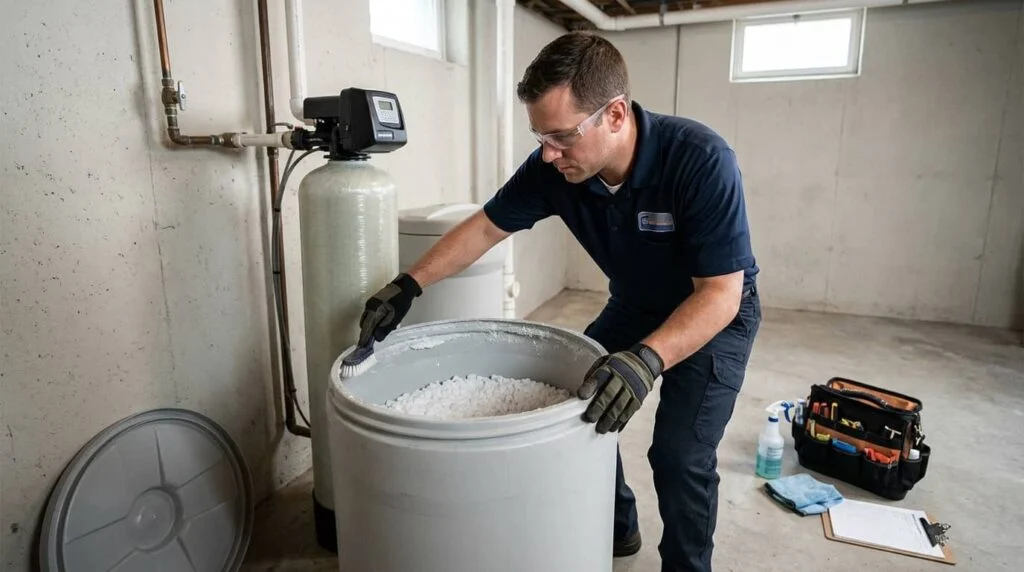
A whole-house RO system treats all water at the point where it enters your home. Every tap, shower, and appliance gets RO water. That sounds ideal, but the setup is much larger. It needs a big storage tank, a pump to push water back into your plumbing, and strong pre-treatment. In hard water areas, that pre-treatment often includes a softener to protect the membrane from scale. RO water also has very low mineral content. Low-mineral water can wear on metal pipes, so many systems add a remineralizing or pH filter after the membrane. As a result, whole-house reverse osmosis Tucson systems take up garage space and need more care. In the under-sink vs whole-house RO debate, this option costs more to buy, run, and maintain.
Whole-House RO Pros and Cons
| Pros | Cons |
|---|---|
| RO water at every tap | Much higher upfront cost |
| Low-mineral water for showers and laundry | Needs a storage tank and pump |
| Less spotting on glass and fixtures | Sends far more water to the drain |
| One system for the whole home | Often needs a softener and pH filter too |
| Useful for very high TDS sources | More parts to service each year |
Under-Sink vs Whole-House RO Side by Side
| Factor | Under-Sink RO | Whole-House RO |
|---|---|---|
| Water treated | Drinking and cooking water | All water in the home |
| Space needed | Kitchen cabinet | Garage or utility area |
| Wastewater | Lower | Much higher |
| Pre-treatment | Built-in filters | Softener, sediment, and carbon |
| Post-treatment | Optional mineral filter | pH or remineralizing filter often needed |
| Upkeep | Simple filter changes | Pump, tank, filters, and membranes |
| Best fit | Most Tucson homes | Special cases with very high TDS |
| Common reverse osmosis Tucson pick | Yes | Rarely |
Water Waste in the Under-Sink vs Whole-House RO Choice
Water use matters in the Sonoran Desert, and it should shape your under-sink vs whole-house RO decision. Tucson Water states that some RO units waste up to 10 gallons to make one gallon of treated water. Newer designs waste less, but every RO system sends some water to the drain. The city also notes that RO adds a salty waste stream to the sewer. With an under-sink unit, you only treat a few gallons a day, so the waste stays small. With a whole-house unit, you treat every shower, load of laundry, and toilet flush. That can multiply the waste many times over. So for most families, a whole-house reverse osmosis Tucson system uses far more water than the home really needs. Our team always keeps that tradeoff in front of you.
Cost Factors to Compare
Price is often the first thing people ask about, but we do not list fixed prices here. Every home has a different layout, water test result, and set of goals. So the real cost of reverse osmosis Tucson homes install depends on a few factors. An under-sink unit has fewer parts, a smaller tank, and a simple drain hookup. A whole-house unit adds a large tank, a pump, pre-treatment, and often a pH filter. Each of those parts adds to the price and to the yearly upkeep. That is why the under-sink vs whole-house RO gap grows wider over time over time. Desert Water Services LLC offers a Free RO Consultation, so you get a clear quote for your home. That quote shows both the install cost and the yearly care for each option. Compare these factors as you plan your reverse osmosis Tucson budget:
- Number of filter stages and membrane size
- Storage tank size or tankless design
- Pump needs for whole-house systems
- Pre-treatment, such as a softener or sediment filter
- Remineralizing or pH filters after the membrane
- Plumbing changes, drain access, and install location
- Yearly filter and membrane costs for under-sink vs whole-house RO
Our Reverse Osmosis Tucson Recommendation
For most reverse osmosis Tucson projects, Desert Water Services LLC suggests an under-sink RO system for drinking water and a water softener for the whole house. This pair covers both main problems in local water. The RO system gives you clean, great-tasting water at the kitchen tap. The softener protects your water heater, pipes, dishwasher, and fixtures from hard scale. Together, they cost less and waste less water than a full whole-house RO system. They also need simpler care. A whole-house unit can make sense when a home has very high TDS, such as some private wells, or when the owner has a specific need. Even then, we test the water first. That way, your under-sink vs whole-house RO choice rests on real numbers, not on a sales pitch.
Quick Guide to Picking a System
- Pick under-sink over whole-house RO if you mainly want better drinking water.
- Pick whole-house over under-sink RO only if your test shows very high TDS.
- Pair a softener with under-sink RO instead of whole-house RO if scale bothers you.
Under-Sink vs Whole-House RO Maintenance
Neither system works well without care. Tucson Water reminds homeowners that home treatment units are not “install and forget” devices. Pre-filters clog with sediment, and carbon filters lose their power to remove chlorine. Once that happens, chlorine can reach and damage the membrane. Hard water also builds scale on membranes faster than soft water does, on both sides of the under-sink vs whole-house RO choice. So you need filter changes on a schedule and a yearly check of the membrane. A simple TDS meter test shows if the membrane still works well. For a full checklist, see our guide to the annual water system tune-up for Tucson homes. It explains what a yearly service includes and why it matters here. With steady care, a reverse osmosis Tucson system can serve your family for many years.
Areas We Serve for Reverse Osmosis in Tucson
Desert Water Services LLC installs and services RO systems across Tucson and nearby Pima County communities. We serve homes in 85701, 85704, 85705, 85710, 85711, 85712, 85715, 85716, 85718, 85719, 85730, 85741, 85742, 85745, 85747, 85748, 85749, and 85750. We also help families in Oro Valley (85737), Marana (85653), Vail (85641), and Sahuarita (85629). We handle reverse osmosis Tucson installs in many kinds of homes. Older homes near downtown and the University of Arizona often have different plumbing than newer homes in Vail or Marana. That difference affects where an RO unit fits and how we route the drain line. Because of that, we look at your home before we suggest anything. We check your sink cabinet, garage space, and water test results. Then we help you settle the under-sink vs whole-house RO question with confidence.
Pick the Right RO Setup for Your Home
The under-sink vs whole-house RO decision comes down to what you really need. If you want clean, great-tasting water for drinking and cooking, an under-sink unit does the job well. If hard scale bothers you, a softener protects the whole house for less money and less waste. A whole-house RO system fits a small group of homes with very high TDS or special needs. For most Tucson families, under-sink RO plus a softener beats whole-house RO. It saves water, saves space, and keeps upkeep simple. Desert Water Services LLC helps you compare both options with your own water test results in hand. That way, you buy the right reverse osmosis Tucson setup the first time. You also avoid paying for treatment your home does not need.
Not sure which RO system fits your home? Book your Free RO Consultation with Desert Water Services LLC today. Call [PHONE NUMBER] and our Tucson team will test your water and walk you through both options.
Frequently Asked Questions
1. Is under-sink or whole-house RO better for a Tucson home?
For most Tucson homes, an under-sink RO system for drinking water plus a whole-house softener gives the best balance. This pair costs less, wastes less water, and needs simpler care than whole-house RO. A whole-house unit fits homes with very high TDS or special needs.
2. How much water does a reverse osmosis system waste?
Tucson Water states that some RO units waste up to 10 gallons to make one gallon of treated water. Newer designs waste less, but every RO system sends some water to the drain. An under-sink unit keeps waste small because it treats only drinking and cooking water.
3. Does whole-house RO need a water softener in Tucson?
Most whole-house RO systems in hard water areas use a softener or other pre-treatment to protect the membrane from scale. Tucson water is hard, so pre-treatment matters here. Many systems also add a pH or remineralizing filter after the membrane.
4. Can an under-sink RO system connect to my fridge?
Yes, many under-sink RO systems can feed the fridge water line and ice maker. That gives you RO water for drinking, cooking, and ice. A technician runs a line from the RO unit to the fridge during install.
5. Does chlorine damage RO membranes?
Tucson Water notes that chlorine can harm some RO membranes. Most systems use a carbon pre-filter to remove chlorine before water reaches the membrane. Changing that pre-filter on schedule protects the membrane.
6. How much does reverse osmosis cost in Tucson?
The cost depends on the system type, filter stages, tank size, pre-treatment, and install location. Whole-house RO costs more to buy and maintain than an under-sink unit. Desert Water Services LLC gives a clear quote after a Free RO Consultation.
7. Does RO water remove the hard water taste in Tucson?
Yes, reverse osmosis removes most dissolved minerals and salts that cause a chalky or flat taste. Tucson Water notes that RO can improve color, taste, and softness. That makes it a popular choice for drinking water in Tucson.
8. Does reverse osmosis protect my pipes from hard water?
An under-sink RO system does not protect your pipes, because it treats only one tap. A whole-house softener protects pipes, water heaters, and fixtures from scale. Many Tucson homes use both systems together.
9. How often should I change RO filters in Tucson?
Change RO filters and membranes on the schedule the maker sets, because hard water and chlorine wear them down. A yearly TDS test shows how well the membrane still works. Tucson Water reminds owners that home treatment units need regular care.
10. Does Desert Water Services LLC install RO systems near me?
Desert Water Services LLC installs and services RO systems across Tucson, Arizona, and nearby areas. The team serves Oro Valley, Marana, Vail, Sahuarita, and many Tucson ZIP codes. Call to book a Free RO Consultation.